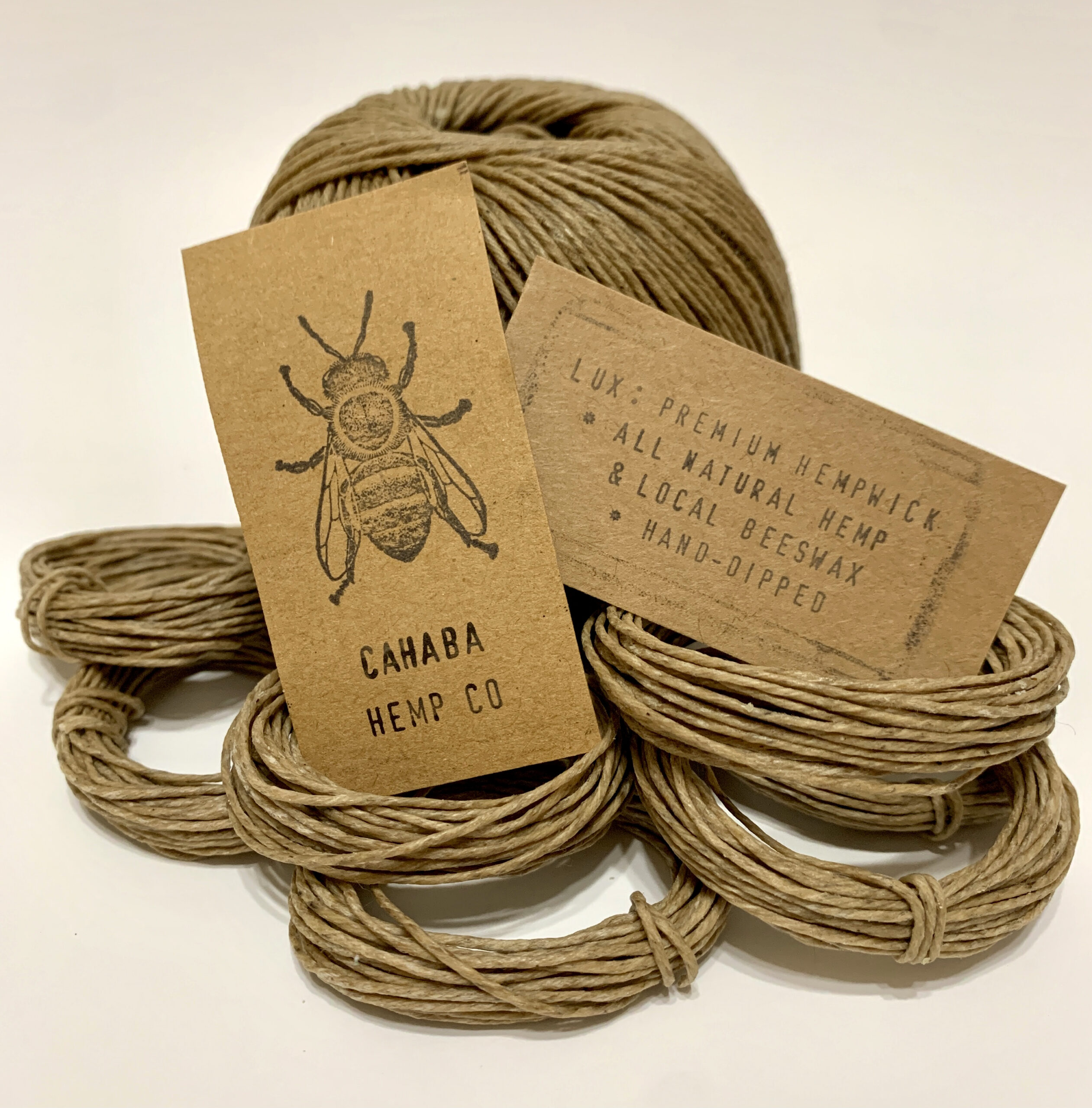
We’re going to make a claim that sounds like marketing, and then we’re going to back it up with details no one else in this industry wants to talk about: Cahaba Hemp makes the highest quality hemp wick in the world, and we have since 2012. It burns slower, it’s cleaner, and it sells out often enough that we keep a reserve list. Here’s exactly why.
What goes into our hemp wick
Two ingredients. That’s the whole recipe, and both of them have a name and an address.
The beeswax comes from local Alabama honey bees, hand-harvested from hives we know personally. It’s never bleached, never filtered through chemicals, never blended with paraffin or filler wax. It goes from the hive to a low-temperature melt to the twine, and that’s it. You can smell the difference the moment you open the bag: real beeswax smells like honey, because it spent its whole life next to some.
The twine is all-natural, handspun hemp from California. Unbleached, minimally processed, 100% hemp fiber with nothing blended in. We coat every inch by hand in small batches, and we quality-test our own work before anything ships.
The slow, even burn follows from all of that. Thick natural wax on clean fiber burns steadily, without the sputtering you get from filler wax, and with no chemical residue, the only thing you taste is your flame doing its job.
What the rest of the industry does
Here’s the part that surprises people. Nearly every other hemp wick company, including the big names, builds their product from Chinese hemp twine and Chinese beeswax, sourced for price rather than quality.
RAW, widely seen as the premium brand in smoking accessories, used Chinese hemp twine for years and openly said Chinese hemp was the best available. Only after customers called them out did they move to European-grown hemp, from sources they don’t say much about. Swapping one mystery supply chain for another is not what we’d call an upgrade.
It goes further than sourcing. There are actual patents on file for hemp wick manufacturing that call for washing the twine in chemical and solvent baths before the beeswax ever touches it. And several companies bleach their beeswax so the finished wick looks lighter and brighter on the shelf. Think about that: chemically stripping a natural product so it photographs better, on an item you hold to a flame and inhale next to.
Our answer to all of it is simple. Clean and natural, never chemical washed or infused. Local suppliers we can name, instead of global mystery sources. And when quality and margin pull in different directions, quality wins, every time it has come up since 2012.
Why local sourcing is the whole point
Every spool of our hemp wick supports an Alabama bee farm and an American hemp farm. That was the reason we started doing this in the first place. Beekeepers keep their hives healthy when there’s steady demand for what the bees make, and hemp farmers can keep growing clean fiber when someone actually buys it. An industry built on hemp and bees ought to put hemp farms and bee farms first, and we think everyone selling hemp wick should be able to tell you the name of their beekeeper. We can.
Even the packaging follows the same rule. Our hemp wick ships in glassine bags, made from wood pulp and fully compostable, printed with plant-based inks. No plastic sleeve, no foil, nothing that outlives the product it protected.
We sell out. We’re okay with that.
Hand-harvesting beeswax and hand-coating twine don’t scale the way a Chinese factory order does. As a result, our hemp wick is often sold out or spoken for on the reserve list, because we’d rather run out than cut a single corner. Meanwhile, most of the industry has spent the past decade hunting for a cheaper manufacturer.
If you want to try the difference for yourself, our hemp wick is available here whenever a batch is in stock, and the reserve list is the surest way to get the next one. Light it, burn it slow, and taste what hemp wick was supposed to be all along.