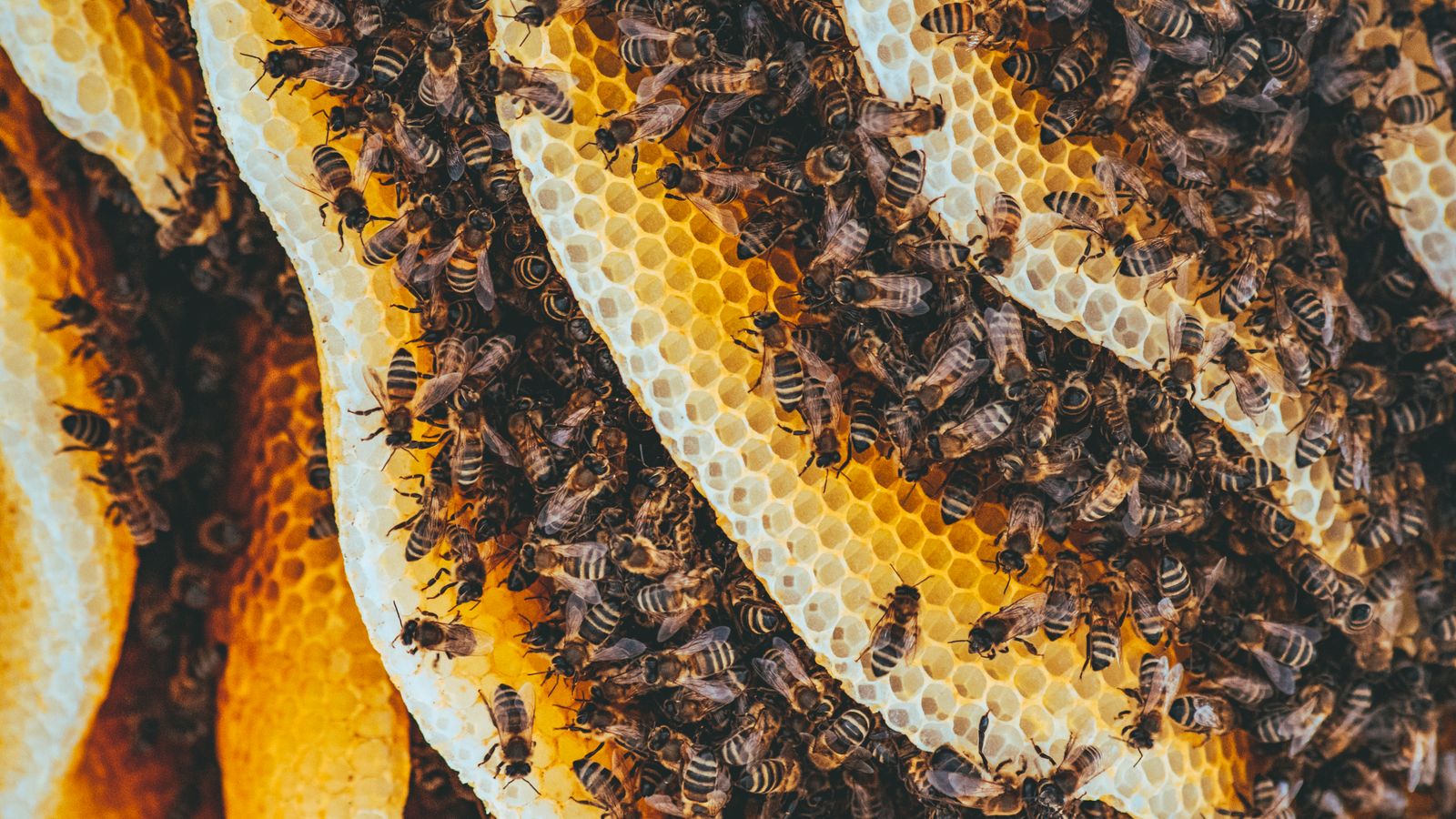
Honeybees are tireless foragers, and they’ll travel farther than most people expect to bring nectar and pollen home. How far depends on what the hive needs and how many flowers are blooming nearby.
As a rule, honeybees will fly up to about 3 miles (4.8 km) from the hive in search of food. Some go even farther when flowers are scarce and they have to range wider to find good sources of nectar and pollen. That’s a long way for an insect that small, especially carrying a load back.
What’s really impressive is how they find their way home. Honeybees navigate using a combination of visual landmarks, the position of the sun, and the earth’s magnetic field. They can also tell other bees where the good flowers are through a behavior called the waggle dance, a series of movements that points hivemates toward the nectar. It’s a genuine language, danced out on the honeycomb.
The magnetic-field part is the most surprising. Bees have tiny structures called magnetosomes in their brains that contain magnetic particles. These are sensitive to the earth’s magnetic field and help the bee work out its orientation and position relative to the hive, like a built-in compass.
When a honeybee heads out to forage, it uses that magnetic field as a reference point to orient itself and find its way back. It leans on visual landmarks and the sun too, but studies show bees rely more heavily on the earth’s magnetic field over longer distances or when clouds hide the sun. So even on an overcast day, miles from home, a bee can still find its way to the front door.