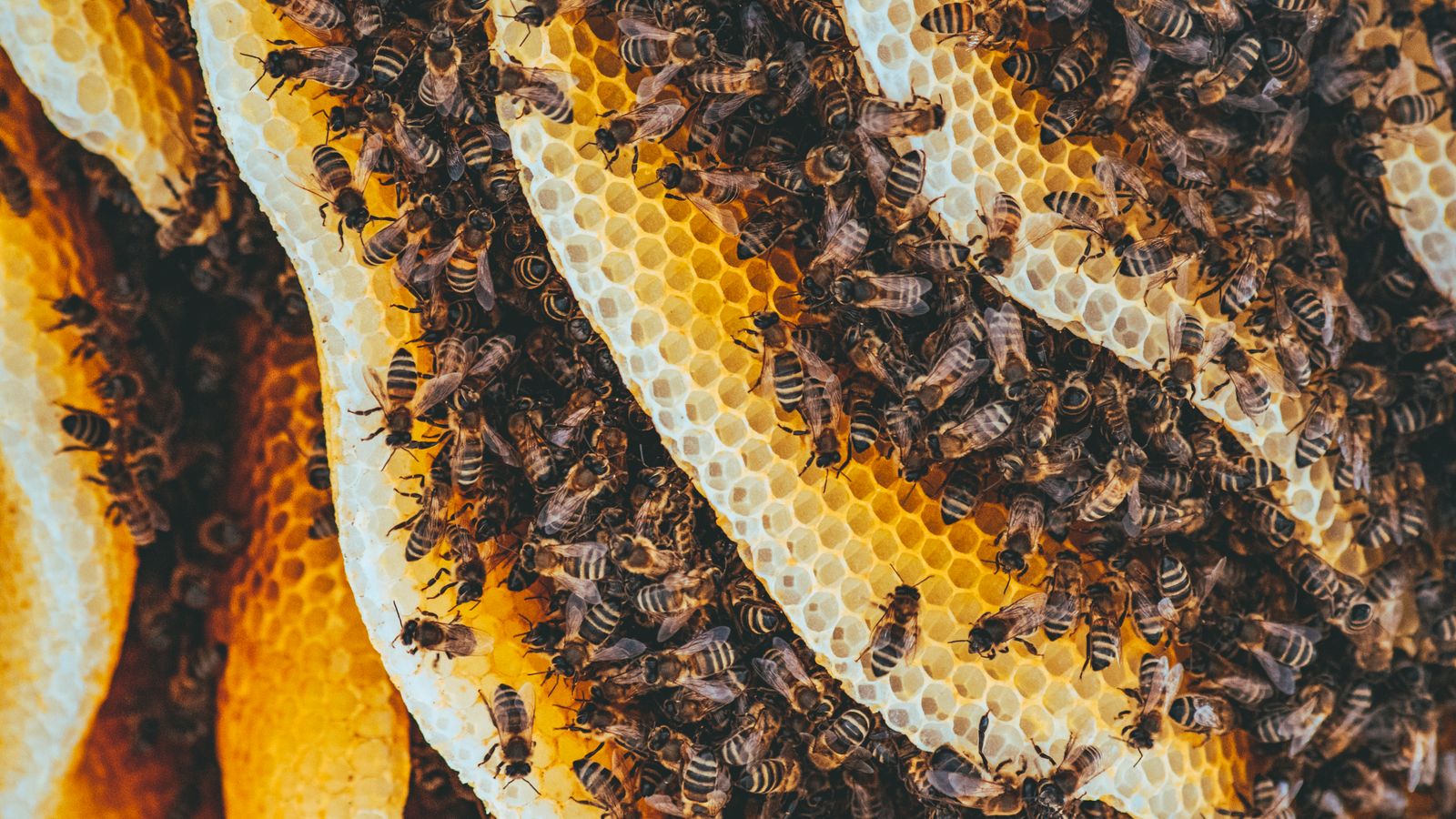
Making honey is a team effort that starts in a flower and ends with a wax-sealed cell in the hive. The short version: bees collect nectar, add enzymes to break it down into simple sugars, spread it across the honeycomb to evaporate and thicken, then cap the finished honey with wax to protect it from moisture and pests. Here’s how each step actually works.
It begins with the forager bees leaving the hive to hunt for nectar-producing flowers. They rely on a sharp sense of smell and the ability to see ultraviolet light, which flowers use like landing strips, to find the blooms richest in nectar. When a forager lands on a good flower, it uses its long, tube-like tongue, called a proboscis, to sip up the nectar.
While it’s collecting nectar, the bee also picks up pollen on its body, a fine powder that’s an important source of protein and other nutrients. This is where pollination happens: as the bee moves to a new flower, some of that pollen rubs off onto the flower’s pistil, its female reproductive organ, fertilizing it. So the bee is feeding the hive and helping the plants reproduce at the same time.
Back at the hive, the forager hands the nectar off to worker bees inside. The workers add enzymes, which break the nectar down into simple sugars and start reducing its water content. They spread the mixture across the honeycomb cells and beat their wings to create a current of air, essentially fanning the nectar to speed up evaporation.
Once the honey has thickened to the right consistency, the workers cap each cell with a wax seal, locking out moisture and pests. From there it’s stored in the hive until the colony needs it for food, or until the beekeeper harvests it. Every jar you open is the end of that whole patient assembly line.