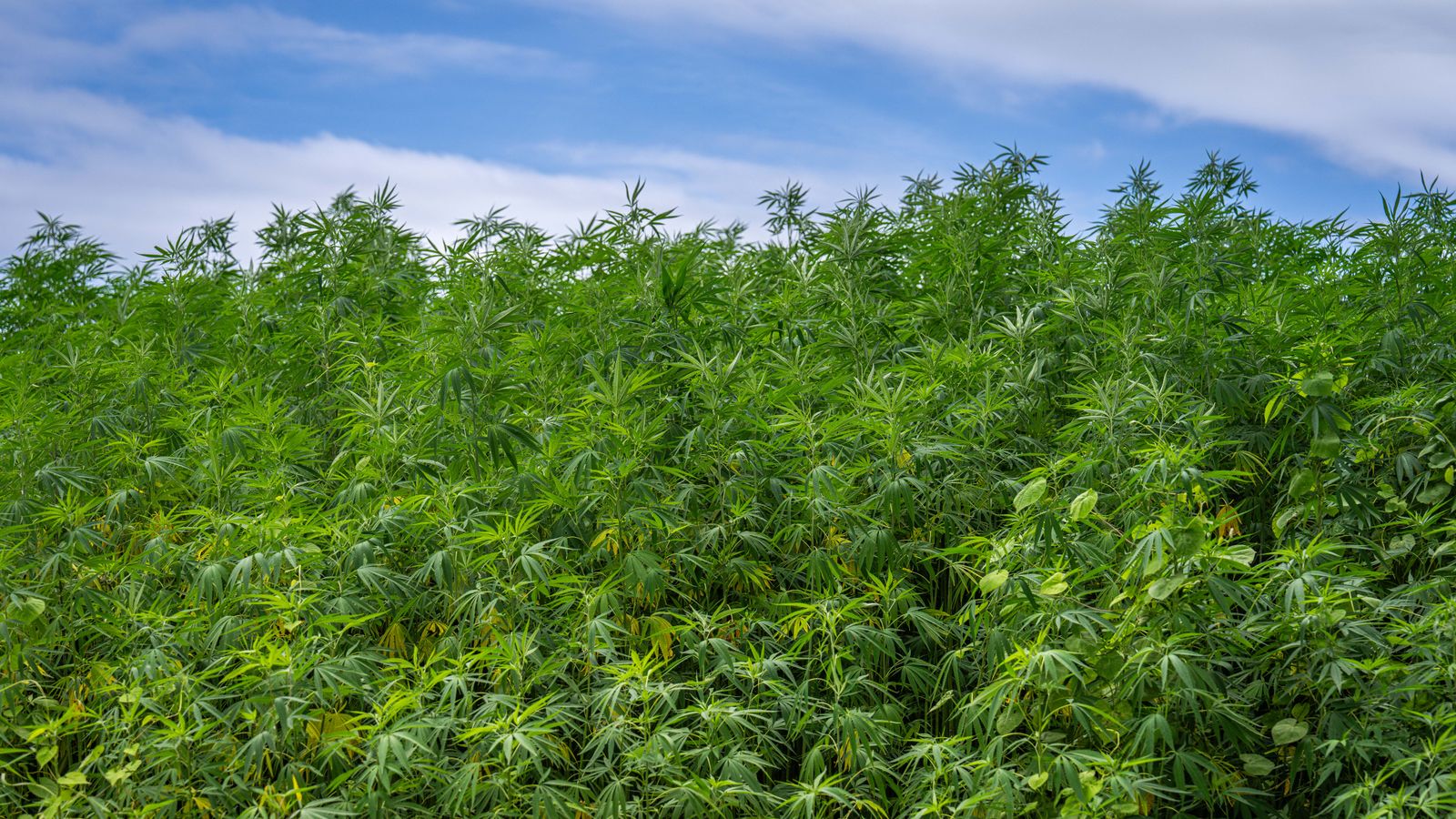
Hemp went from a crop the U.S. government required colonists to grow, to a federally banned substance, and back to a legal industry, all in about 400 years. It’s a strange and revealing story, tangled up with medicine, racism, corporate interests, and international treaties. Here’s the short version.
The colonial era
Hemp’s American history starts with the early colonists at Jamestown. In 1619, King James I ordered the Jamestown colonists to grow and ship 100 hemp plants to England to help support the country. Hemp mostly went into sails, ropes, paper, and clothing, since it was more durable than other fabrics. George Washington, Thomas Jefferson, and Benjamin Franklin all grew it to help support the colonization of the Americas. For a long stretch, hemp was simply a valuable crop.
Cannabis as medicine
In the 1850s, cannabis showed up as medicine in pharmacies, after Irish doctor William O’Shaughnessy introduced it to Western medicine in 1839. He’d used it extensively as a surgeon with the East India Company, then brought hemp medicine to the UK and Ireland. He created a hemp tincture called Squire’s Extract and spread knowledge of hemp medicine through the medical community; Queen Victoria was even one of his patients. By the early 20th century, though, hemp medicine had faded, pushed out by the discovery of opiates and the arrival of the syringe.
The 1930s turn
In the 1930s, cannabis’s reputation got dragged down by a mix of sensationalism and racism. Many immigrants were arriving from Mexico and bringing their crops, marijuana among them. Harry Anslinger, head of the Federal Bureau of Narcotics, teamed up with newspaper publisher William Randolph Hearst and the DuPont Company, a maker of nylon, to push for banning hemp and cannabis in the United States. Each had his own motive, and none of them had much to do with public health.
The Marihuana Tax Act of 1937
The blow landed in 1937 with the Marihuana Tax Act, which slapped a heavy tax on the sale and cultivation of marijuana, a plant frequently confused with hemp. President Franklin D. Roosevelt signed it into law on August 2, 1937.
The act was a response to growing worry about marijuana use. Marijuana wasn’t actually widespread or well-known at the time, but there were concerns about its use among a small number of people, particularly Mexican immigrants. Some also feared it was becoming a substitute for alcohol during Prohibition, or that it was a “gateway drug.” The tax made growing or selling marijuana difficult and expensive, which was meant to curb its use.
But it had a major unintended consequence: it lumped hemp in with marijuana. Because hemp got confused with its psychoactive cousin, it was subject to the same taxes and regulations, and U.S. hemp cultivation dropped sharply. By the 1950s it had all but stopped.
Going global
Other countries followed America’s lead, and it culminated in the 1961 United Nations Single Convention on Narcotic Drugs, which gave cannabis Schedule I status. That treaty aims to control the production, distribution, and use of drugs deemed to have high abuse potential, and Schedule I is reserved for those considered highly prone to abuse with no accepted medical use.
Adopted in 1961 and in force by 1964, the convention pulled together and updated several earlier drug-control treaties, including the 1931 convention on manufacturing narcotic drugs, the 1936 protocol on the poppy plant, and the 1948 protocol on narcotic drug manufacture. Over 180 countries have ratified it, making it one of the most widely accepted drug-control treaties, and beyond cannabis it set up international controls on opiates, cocaine, and amphetamines.
Putting cannabis in Schedule I has been controversial ever since, since many people believe it has medical value and should be reclassified. Some countries have moved to legalize or decriminalize it anyway, and in recent years there have been calls to update the treaty to reflect newer scientific understanding.
The Controlled Substances Act
The Marihuana Tax Act stayed in effect for decades until it was repealed in the 1970s and replaced by the Controlled Substances Act (CSA), passed in 1970 as part of the Comprehensive Drug Abuse Prevention and Control Act. The CSA is the main U.S. law governing the possession, use, and distribution of controlled substances.
It sorts substances into five schedules based on abuse potential, accepted medical use, and risk of dependence. Schedule I, which includes heroin, LSD, and marijuana, is for drugs deemed to have high abuse potential and no accepted medical use. Schedule II drugs like cocaine, methamphetamine, and oxycodone have high abuse potential but some medical use, while Schedules III, IV, and V (anabolic steroids, Xanax, codeine cough syrup) run progressively lower in abuse and dependence risk.
Under the CSA it’s illegal to manufacture, distribute, or possess controlled substances without government authorization, and the law created the Drug Enforcement Administration (DEA) to enforce it. The CSA has been amended many times, and it remains central to U.S. drug policy, though the classification of marijuana as Schedule I has drawn plenty of criticism.
The 2018 Farm Bill
Hemp finally came back into the legal fold with the 2018 Farm Bill, formally the Agriculture Improvement Act of 2018, signed into law that December. The bill covered a lot of agricultural ground, but it’s best remembered for its hemp provisions.
It removed hemp, defined as Cannabis sativa L. with no more than 0.3% delta-9 THC by dry weight, from the CSA’s list of controlled substances. That effectively legalized hemp federally and let states regulate the production and sale of hemp products, including CBD oil. The bill also set up a federal program to regulate hemp production, allowed for state-level regulatory programs, authorized cultivation for research, and provided for marketing hemp and hemp-derived products.
The hemp industry saw it as a major win, since it opened up new opportunities and cleared away many old legal barriers. There’s been some confusion about implementing the details, and some states have taken a more cautious approach, but the direction was clear.
Where things stand
Today, marijuana is still illegal at the federal level, though a growing number of states have legalized it for medical or recreational use. Hemp, meanwhile, is a thriving industry again, used to make textiles, building materials, food products, and dietary supplements. After a 400-year detour through prohibition, the crop the founders grew is finally legal to farm once more.